 Golf Wiki
How to film your golf swing
A phone on a tripod is enough to see your own swing. What matters is where the camera stands: at hand height, three to four metres away, either square to the target line or parallel to it. This article sums up seven coaching guides and says where they disagree.
What a video shows, and what it does not
A video lets you see what you cannot feel: posture, the path of the club, balance. Many coaches also accept clips for lessons at a distance. Foy Golf Academy points out the limit: video shows movement, not exact values such as the angle of the clubface at impact.
The position of the camera changes how a swing looks. The Sand Trap and Foy Golf Academy both stress that a different angle is easily mistaken for a different swing. Film the same way every time, or two clips cannot be compared.
The two views
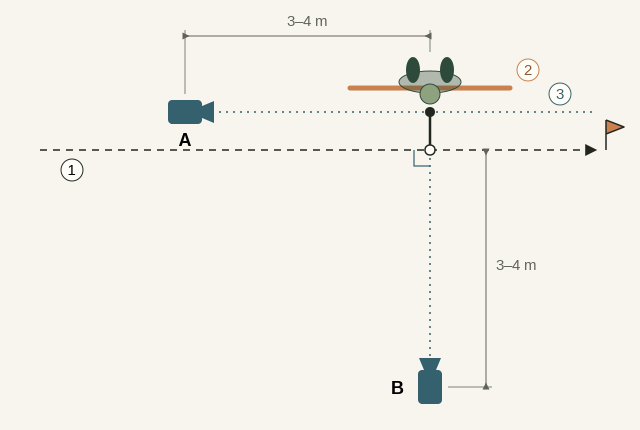
Coaches work with two views. Face-on (B in the sketch): the camera stands opposite your chest, at a right angle to the line from ball to target. Down the line (A): the camera stands behind you and looks towards the target, parallel to that line.
Onform describes what each view is for: down the line shows the takeaway, the plane and the path of the club; face-on shows weight shift, rotation and balance.
Camera height
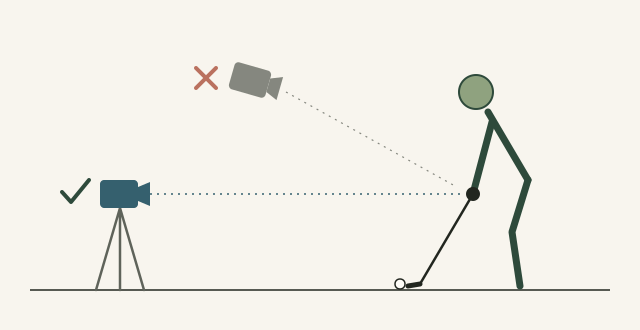
Four of the seven guides say the same thing: put the lens at the height of your hands at address. These are The Sand Trap, Jonathan Yarwood on GOLF.com, Foy Golf Academy and Steve Thomas. The others are close to it: V1 Sports says belt height, Christoph Bausek says about navel height and aimed at the hands, Onform says between waist and chest.
Do not film from eye height. Steve Thomas writes that this makes the club look steeper than it is. Keep the camera level rather than tilted. The Sand Trap counts a phone lying on the ground as a mistake, because height and angle can no longer be controlled.
Distance and framing
Steve Thomas gives 3 to 4 metres. Foy Golf Academy, Onform and V1 Sports give 10 to 12 feet, which is about 3.0 to 3.7 metres (our conversion). The Sand Trap allows 8 to 12 feet down the line and 6 to 12 feet face-on, about 2.4 and 1.8 metres at the short end (our conversion).
The whole body and the whole club must stay in the picture through the entire swing. Yarwood's check: feet and ball at the bottom edge, room at the top for arms and club. Foy Golf Academy advises the normal lens, not the ultra-wide one.
Down the line: which line? The sources disagree
All sources agree that the camera looks parallel to the line from ball to target. They disagree on where it stands. Yarwood, Foy Golf Academy, Steve Thomas and Bausek put it on the line of the hands. The Sand Trap prefers a line through the big toe of the rear foot. Onform and V1 Sports point the camera along the target line itself.
The Sand Trap rejects a camera behind the ball because of parallax. Yarwood says a camera on the line of the ball or of the backside makes the club hard to see in some positions. Our suggestion, following the majority: the line of the hands. If your coach asks for another line, use that one, and note which line you used.
Aligning the camera with a stick
Lay an alignment stick or a spare club on the ground, parallel to the line from ball to target. The Sand Trap places it just in front of the toes; Foy Golf Academy says outside the path of the club. Foy also warns against aligning the camera with the edge of a range mat, because the mat need not point at your target.
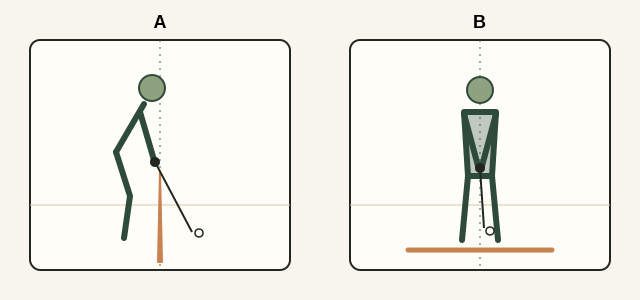
The stick is your check in the picture, as Bausek describes it. Down the line (A), it runs as a straight vertical line through the middle of the screen. Face-on (B), it lies parallel to the bottom edge of the picture.
Face-on, the guides centre the camera slightly differently: on the middle of the stance (The Sand Trap, Foy Golf Academy), on the ball (V1 Sports) or on the hands (Bausek). The Sand Trap lays a second stick at a right angle through the middle of the stance and sets the camera on that line. Onform and V1 Sports describe the same T shape.
Settings on the phone
Use a tripod or a firm holder. A friend holding the phone changes height and tilt from swing to swing, writes Foy Golf Academy.
Film in slow motion if the light allows. The figures differ: 120 frames per second (Foy Golf Academy, Bausek), 240 (Steve Thomas), 200 to 300 (The Sand Trap). A short exposure matters as much: The Sand Trap names 1/1000 of a second or faster, Bausek 1/2000. Outdoors in daylight a phone reaches this easily; indoors the club often blurs.
Landscape or portrait? Steve Thomas films in landscape. Foy Golf Academy accepts portrait as long as the whole swing fits. Yarwood films at full speed and trims the clip to the swing.
Safety and consideration
This section is our own advice and comes from no source. Place the tripod where neither the club nor a mishit ball can reach it. The Sand Trap notes that a camera set too close down the line comes near the arc of the club.
On the driving range, stay in your own bay and keep the walkway free. Ask before other people appear in your picture, and ask the club whether tripods are allowed.
Not established
We found no measured study of how strongly the camera position distorts the picture of a swing. The sources are guides by coaches and by makers of video software, and they disagree on the line for the down-the-line view.
Foy Golf Academy attributes the hand-height advice to the PGA of America; we did not find the original page. Two further guides (Titleist, GolfWRX) refused our request with error 403 and were not used. The sketches show a right-handed golfer; left-handers mirror them.
In this wiki
Sources
- The Sand Trap: Recording Your Golf Swing (Erik J. Barzeski, 2021/2024) — read
- GOLF.com: How to properly film your golf swing (Jonathan Yarwood, 2024) — read
- Foy Golf Academy: How to Film Your Golf Swing (2026) — read
- Steve Thomas Golf: How to Film Your Golf Swing on Your Phone (2026) — read
- Progressive Golf (Christoph Bausek): Online Golf Training — read
- Onform: How to Video Your Golf Swing for Better Analysis (2025) — read
- V1 Sports: How To Film Your Golf Swing (2026) — read
As of 14 Nov 2026. Own summary; no third-party text copied. Sketches drawn by us.